Tape a three-day notice to a door in a Lubbock park without sending the written late-rent notice first, and a judge can toss the eviction case. That apartment habit trips up more park owners in Texas than any other single mistake. It’s also why the mobile home park eviction rules deserve their own conversation. Residents own the home. The dirt under it belongs to the park. Texas built a separate statute around that split, and both sides need to understand it.
What Are the Legal Grounds for Mobile Home Park Eviction in Texas?
For years I assumed a park owner in Texas could end a lot tenancy for any reason the lease allowed. I figured it worked the way a landlord ends a standard rental. Wrong on both counts.
Chapter 94 of the Property Code governs manufactured home lot tenancies in Texas. It spells out the reasons that hold up in court. Breaking a lease provision is the main ground for ending the lease. A community rule folded into the lease counts too. In practice that means junk piling up under a home, unregistered vehicles or pets outside the written limits.
Park rules carry weight here, though they have limits. Under the statute, a landlord can adopt community rules so long as they aren’t arbitrary or capricious. Those rules then count as part of the lease agreement. Write a rule on a napkin in March and enforce it in April, and a justice of the peace in Bexar County will have questions.
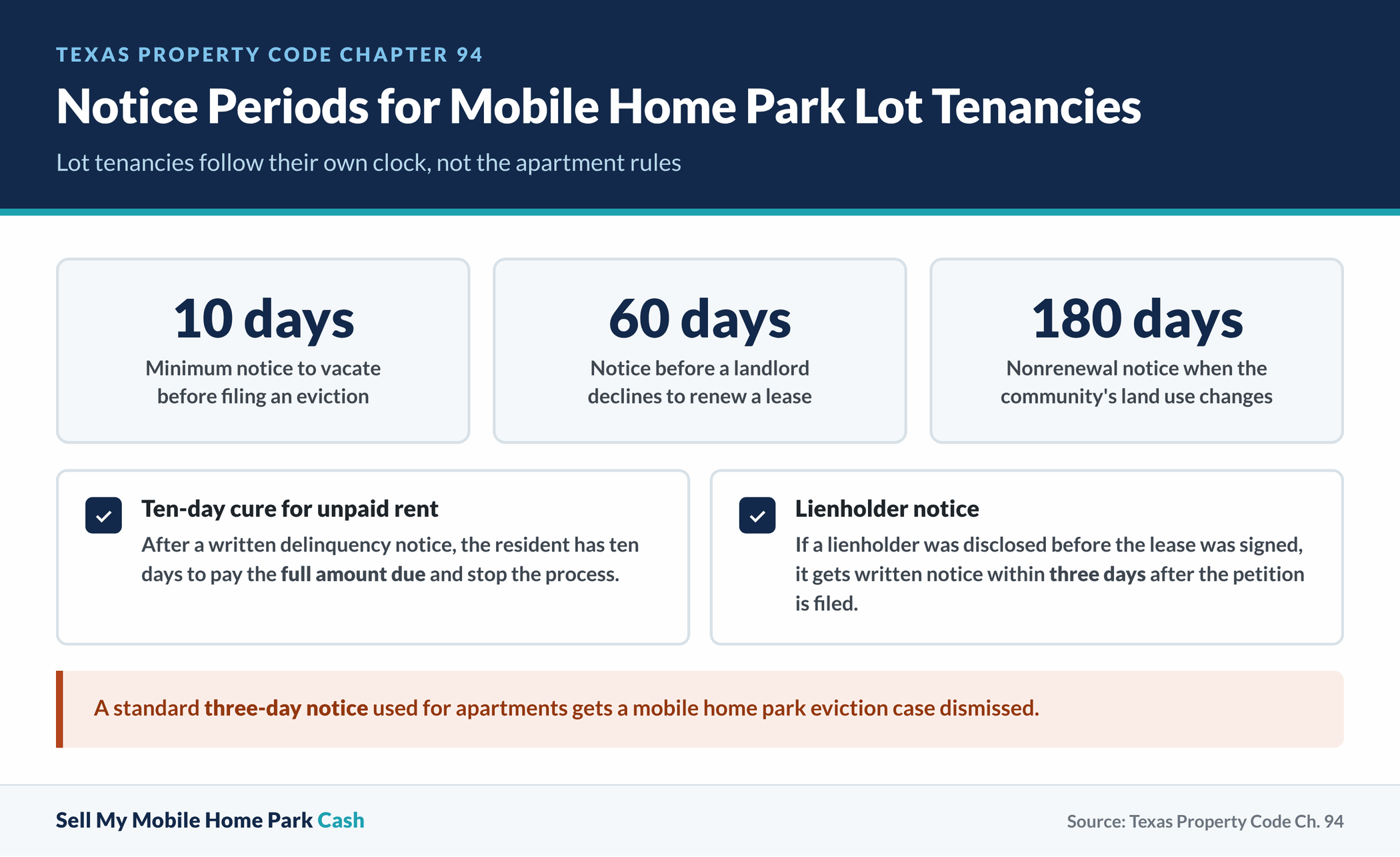
Nonrenewal has its own rules. A landlord must give at least 60 days’ notice before declining to renew a lease. That stretches to at least 180 days if the land use of the community is changing. Park owners in fast-growing corridors around Round Rock and Katy have sold out to developers over the last few years. Nobody moves a 1978 singlewide the way they’d move a sofa, which is why the longer window exists.
The strongest mobile home park eviction cases in Texas are the boring ones, and some owners won’t like hearing it. They come with a clean ledger, dated notices, photos of the violation and a rule that existed before the conduct did. Judges reward paperwork, not outrage.
Reading this from the tenant side? Your strongest ground is almost always procedural. If the park skipped a step Texas law requires, the case can stall even when you owe money.
How Do You Serve an Eviction Notice in a Texas Mobile Home Park?
One missed deadline in Harris County can cost you thirty days of unpaid lot rent. Serve the wrong notice and the case gets dismissed. Then you start the whole clock over as the lot sits unpaid.
Owners new to manufactured home communities often reach for the standard three-day notice to vacate used for apartments. For unpaid rent, Chapter 94 puts another step in front of it: a written delinquency notice and a chance to pay. Skip that step and the mobile home park eviction gets dismissed outright. This one requirement separates these cases in Texas from a run-of-the-mill forcible detainer.
Cure rights come in layers. First, the landlord’s written notice has to say the rent and other payments are delinquent. From the day the tenant receives that notice, they get ten days to tender the full amount due. Pay inside that window and the process stops cold.
Then there’s the lienholder piece. Almost nobody outside the industry knows about it. Say the tenant disclosed a lienholder’s name before signing the lease. In that case the landlord must give that lienholder written notice of the eviction proceedings within three days after filing the petition for judgment of possession. Finance companies have money tied up in that home, so Texas gave them a seat at the table.
Write down how you delivered every notice: the date, the time, the method and who handed it over. I’ve watched landlords lose otherwise clean cases because they couldn’t prove the notice to vacate ever reached the resident.
One more thing for park owners across Texas: certified mail costs a few dollars. It settles arguments that would otherwise cost you a month, which makes it cheap insurance. Of the small Panhandle parks I’ve bought, the ones with a simple notice log almost never lost on service.
Some owners decide all this record-keeping is heavier than the income justifies. Sell My Mobile Home Park Cash buys communities in that exact condition, occupancy problems and all. We don’t ask an owner to clean up the rent roll first.
What Is the Mobile Home Park Eviction Timeline in Texas?
Last year I bought a park outside Temple where one lot’s case was still on the docket. The resident on that lot had built the doublewide’s screened porch herself. She spent two of her last weeks on the lot deciding whether to move it or sell it in place.
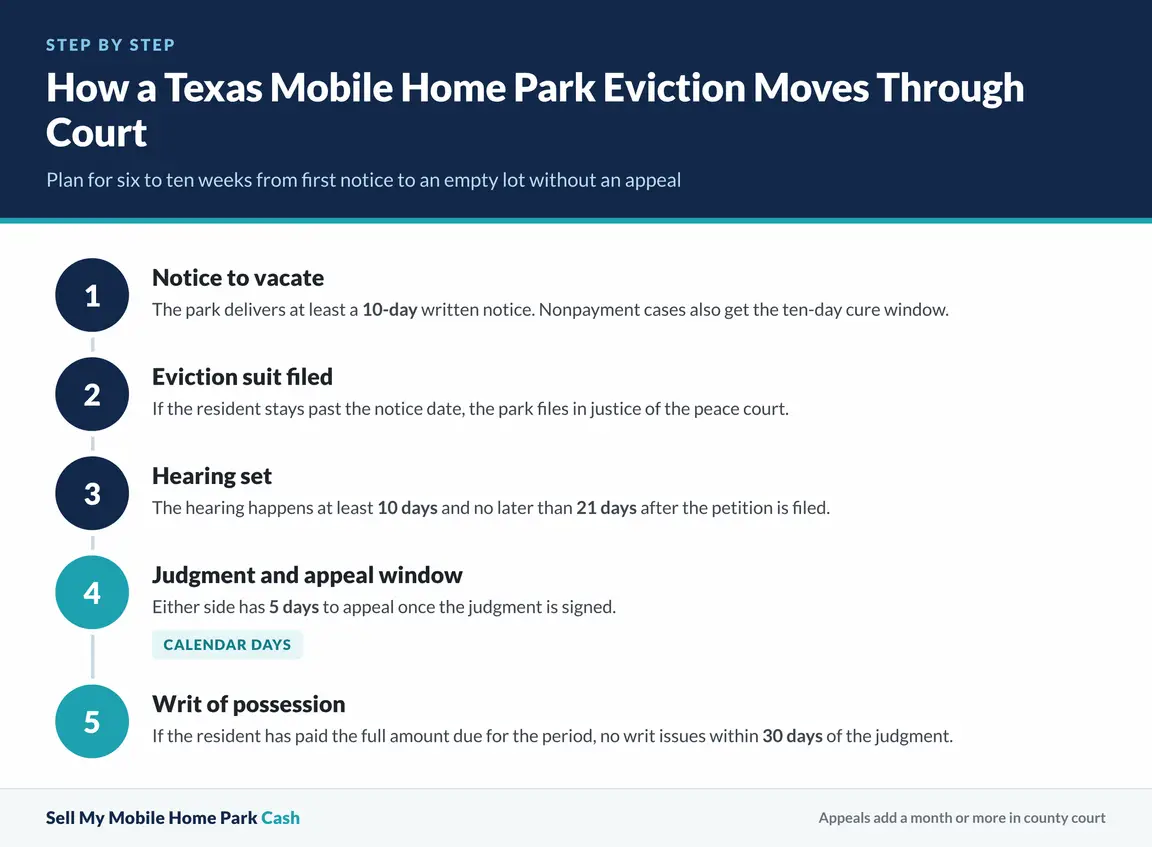
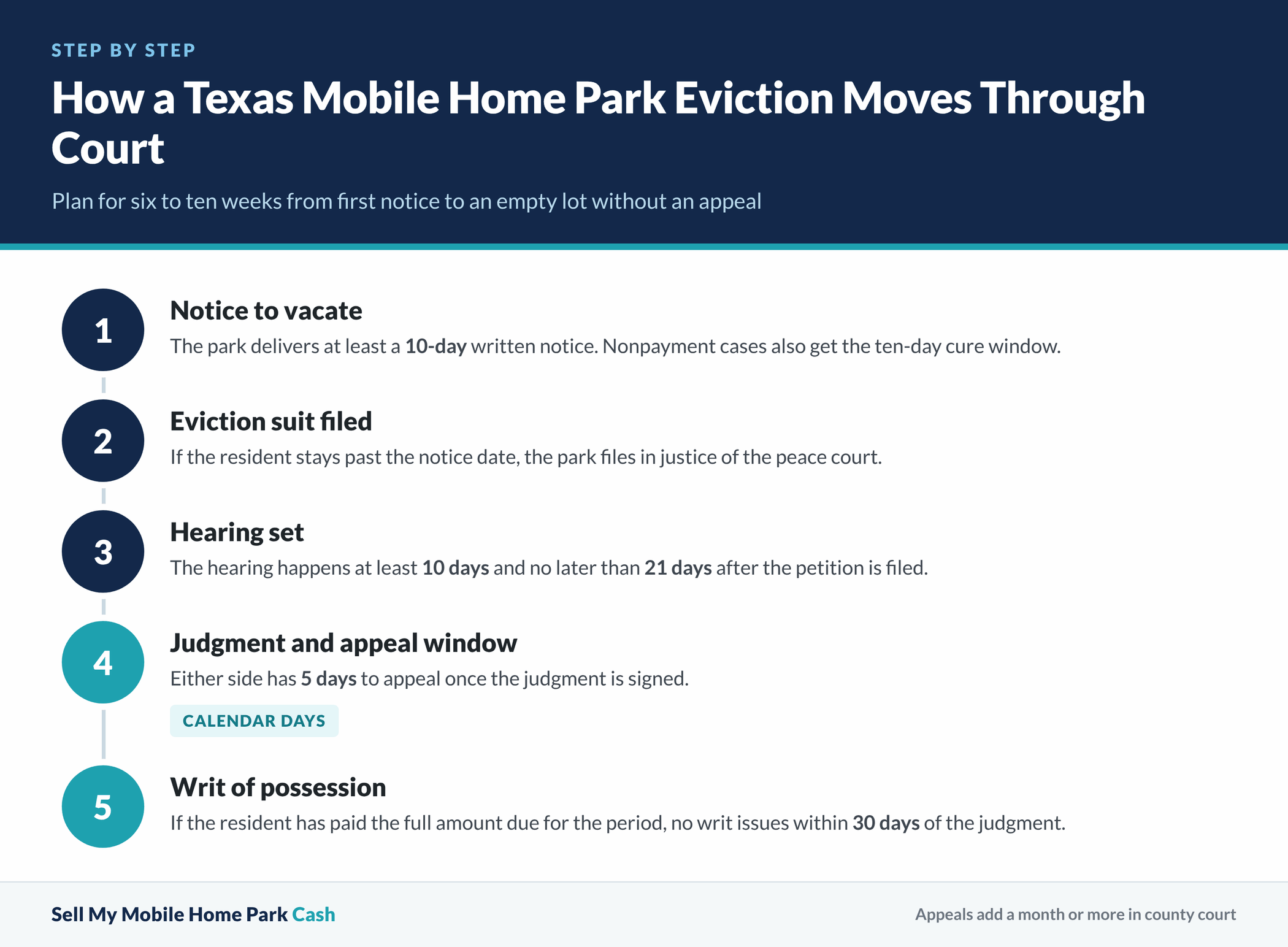
Texas moves eviction cases fast once the notice period burns off. If the tenant doesn’t move out by the date in the notice to vacate, the landlord files an eviction suit in the justice of the peace court. Hearings get set between 10 and 21 days after the petition is filed. Even the earliest hearing date leaves a tenant time to prepare.
Add the ten-day delinquency notice on the front end, and you’re looking at roughly a month before anyone sees a judge.
After judgment, nothing happens instantly. The losing side first gets a short window to appeal. There’s also a protection unique to manufactured home tenancies: a writ of possession won’t be issued within 30 days of a judgment for possession. It applies only when the tenant has paid the full amount due under the lease for that period.
Read that twice if you own a park in Texas, because it’s the step owners budget wrong.
For a contested park eviction in Texas, my planning number is six to ten weeks from first notice to an empty lot, assuming no appeal. With an appeal, add another month or more while the county court schedules a new trial.
Landlords underestimate that window all the time. You can’t promise a new resident a lot on a specific date while an eviction is still working through the docket.
What Happens at the Eviction Court Hearing in a Mobile Home Park Case?
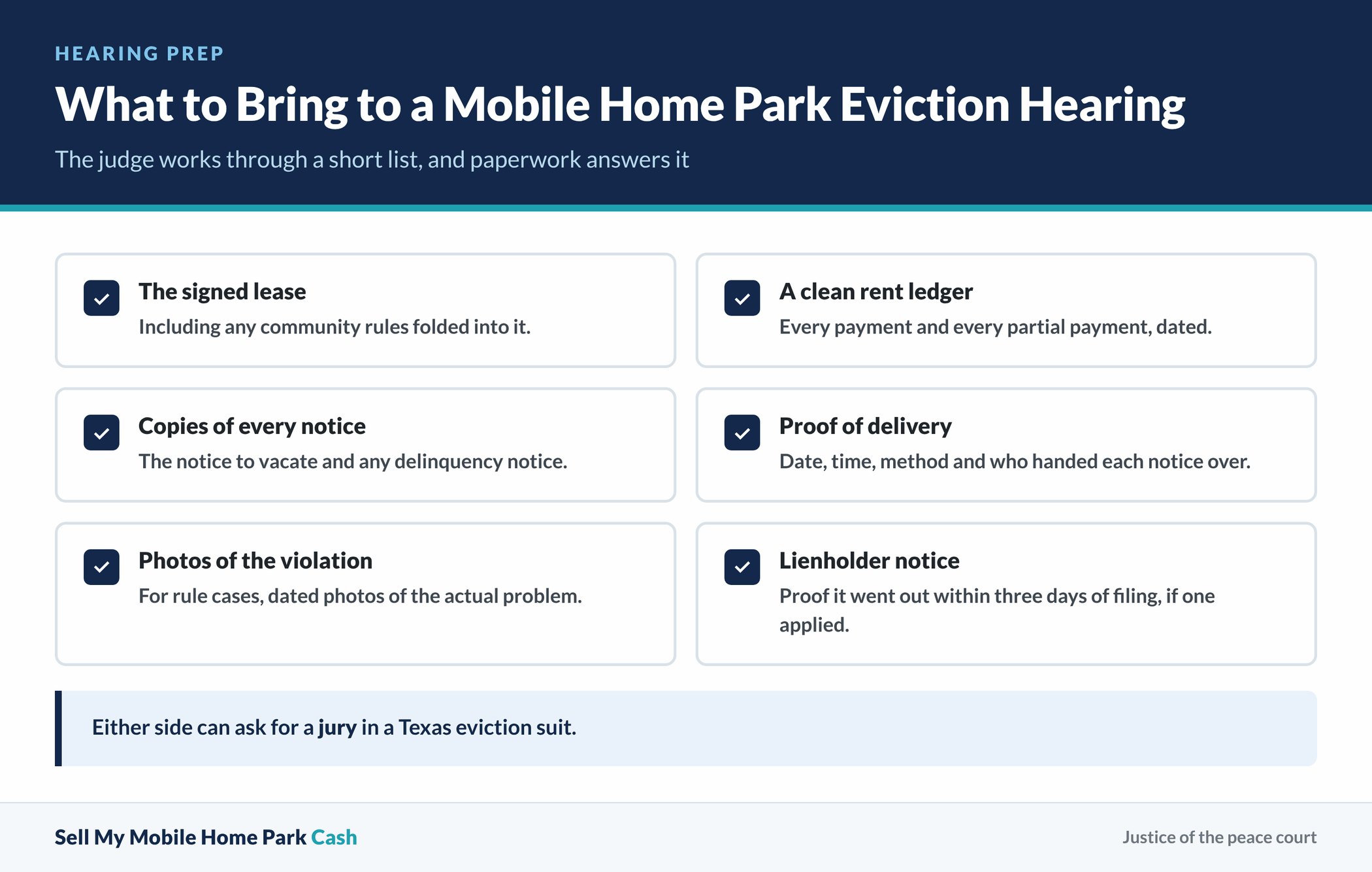
Bring the lease, the ledger and the notices. Expect the judge to ask for all three. Nothing you say will stand in for them.
Justice court is informal compared to district court, but it’s still a civil case with real consequences. In these cases the park is the plaintiff. Residents named in the petition are the defendants. Tenants usually don’t have to file a written answer in justice court. A park can still ask the judge for summary disposition, which is a ruling without a trial. In a lot lease case that motion has to sit on file at least 14 days before the judge can act on it. The 4-day fast track in the rules covers squatters, not residents with a lease.
The judge in a Texas mobile home park eviction works through a short list. It starts with a valid lease and proper notice, given on time. Next comes whether the ground for eviction fits what Chapter 94 permits. Last is whether the landlord sent the lienholder notice, if one applied.
Either side can request a jury in an eviction suit in Texas, which surprises people.
Entry of judgment restarts the clock. Once judgment is entered, the losing party’s appeal window opens right away. No writ of possession can issue until it closes. If the park wins by default, the court also has to mail the judgment to the tenant within 48 hours, with copies going to any lienholder who was notified.
Tenants who can’t afford a lawyer can find free legal help across Texas. The State Law Library keeps plain-language guidance on the eviction process at sll.texas.gov. Local aid organizations in Houston, Dallas and the Rio Grande Valley also handle these cases regularly.
I’ve sat in the back of a few of these hearings. Park owners who send a property manager with a shoebox of receipts tend to lose to residents who show up with one organized folder.
Preparation beats position more often than it should.
Can a Tenant Fight a Mobile Home Park Eviction in Texas?
Five calendar days. That’s the whole appeal window, weekends included. Under Rule 510.19 of the Texas Rules of Civil Procedure, the count starts the day after the justice court judge signs the eviction judgment. If the last day lands on a weekend or holiday, your appeal deadline moves to the next business day.
Yes, a tenant can fight this process in Texas. Some defenses end a case outright. Improper notice is the big one. If the park cut the cure period short or never notified a lienholder, the resident has something real to argue.
Retaliation is another. A court won’t approve an eviction if it finds the eviction was retaliatory. Report a drainage problem to the county and get a notice to vacate the next week, and the timing itself turns into evidence.
An appeal is perfected when the appellant files a bond, a cash deposit or a Statement of Inability to Afford Payment of Court Costs with the justice court. Staying in the home takes more than that. Since January 1, 2026, any tenant who appeals a residential eviction has to pay the rent set in the judgment into the justice court’s registry within 5 days to stay in the home. That’s true whatever the eviction was for and however the appeal was filed. The Texas State Law Library explains the mechanics at guides.sll.texas.gov.
On appeal, the case gets a trial de novo in county court. All the evidence from the justice court trial is heard again by a new court.
Some residents decide fighting isn’t worth five weeks and a bank balance. Selling the home to an incoming resident, with park approval, can leave a family with cash instead of a judgment.
What Illegal Eviction Practices Should Mobile Home Park Owners Avoid?
A manager near Beaumont got tired of waiting on the docket and shut off a lot’s water. By that afternoon the resident had called a lawyer. What should have been a routine mobile home park eviction turned into a lawsuit against the park.
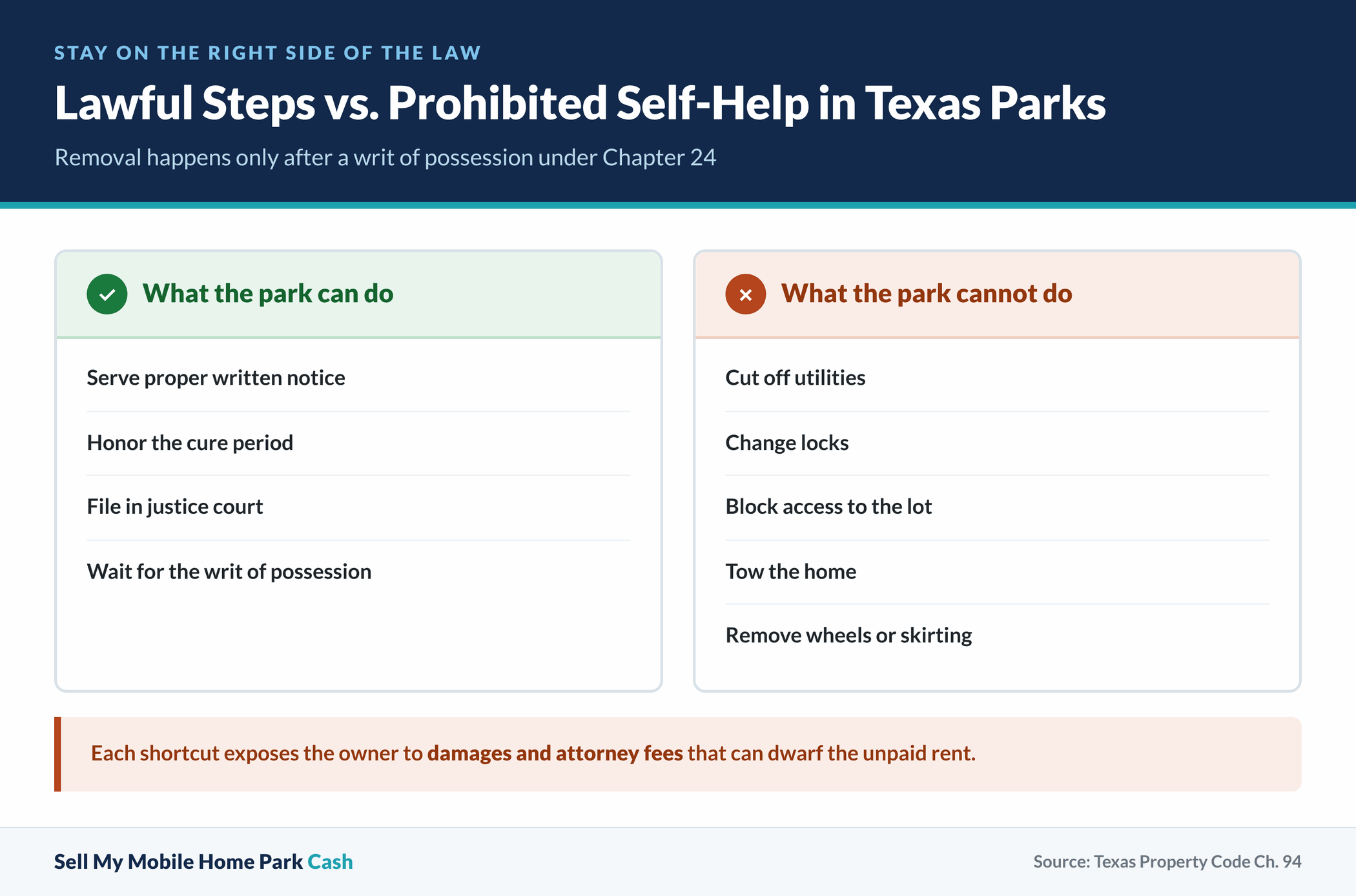
Self-help eviction is flatly prohibited. Under the statute, a landlord can keep a tenant off the lot, evict a tenant or require removal of a manufactured home only after getting a writ of possession under Chapter 24.
The prohibited list is short and unforgiving. Cutting utilities and changing locks are on it, along with blocking lot access. So are towing the home and pulling wheels or skirting to immobilize it. Each one exposes a Texas park owner to damages and attorney fees that dwarf the unpaid rent. Even after a lawful writ, a park that removes the home has to tell the tenant in writing where it went within 10 days.
Rent pressure gets scrutiny too. Raising rent or cutting services across the whole community, as part of a pattern, sits outside the retaliation rules. Singling out one household gets a much harder look once that resident complains.
Selective enforcement is the quieter trap. Letting three residents park boats on their lots and then citing the fourth for it hands that fourth resident a defense.
Timing matters here, and so does the market. Texas Realtors reported on October 20, 2026 that the statewide median sales price slipped 0.4 percent to $333,628 in the third quarter. Active listings rose 2.8 percent and closed sales fell 2.4 percent over the same period. Softer conditions can mean a longer wait for a replacement resident. Shortcuts get more tempting in that kind of market, and more expensive.
How Does the Texas Fair Housing Act Affect Mobile Home Park Eviction?
Can your landlord evict you for the wrong reasons? Another layer of law sits beyond Chapter 94 and reaches every mobile home park eviction in Texas. Breaking it costs more than losing the case.
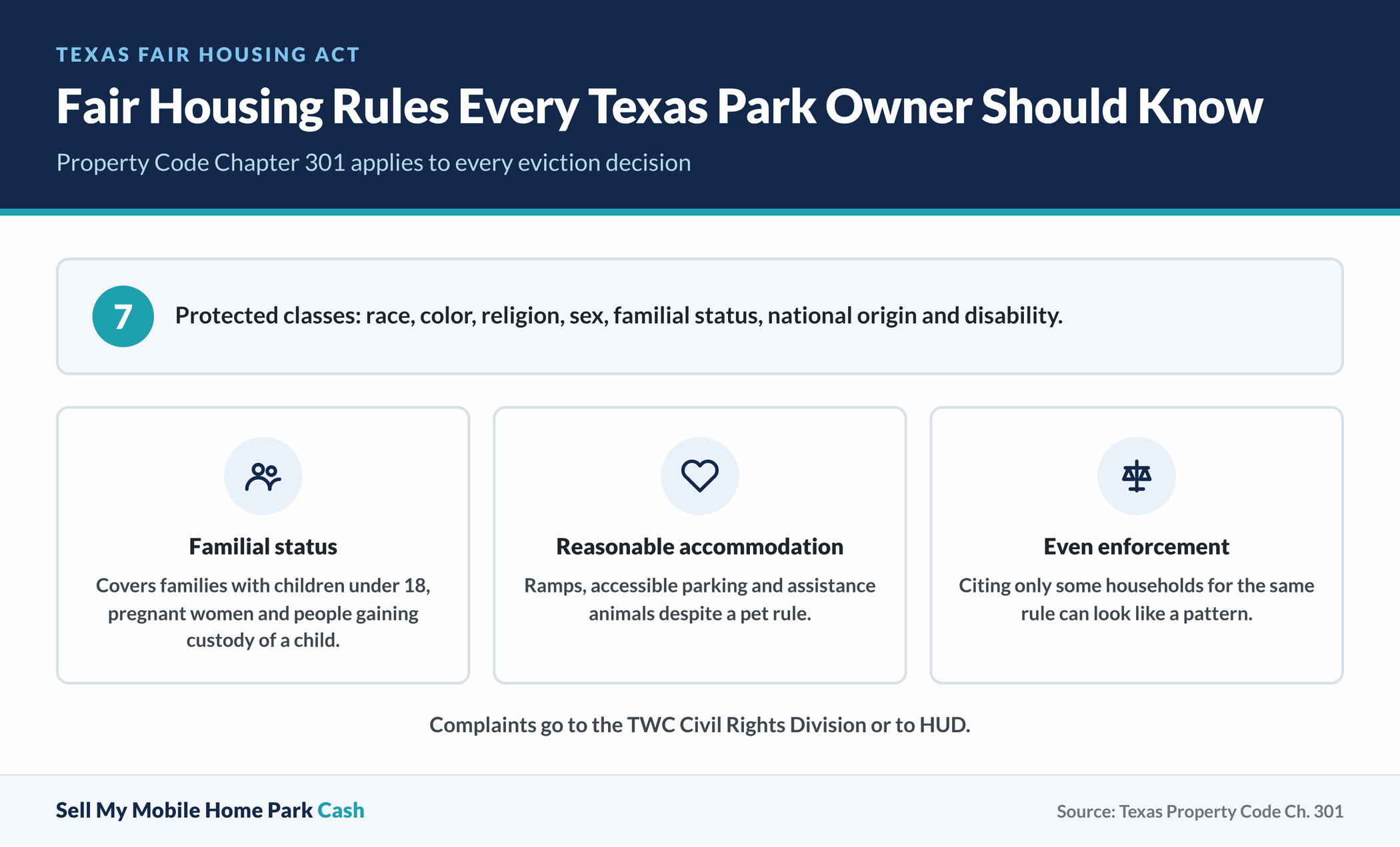
The Texas Fair Housing Act, found at Texas Property Code Chapter 301, makes discrimination illegal in any housing transaction based on protected characteristics. Race, color, religion and sex are protected. Familial status, national origin and disability round out the seven. Park owners get tripped up most by familial status, which covers families with children under 18, pregnant women and people gaining custody of children under 18.
Complaints go to a specific office. In Texas, the Texas Workforce Commission Civil Rights Division administers the Texas Fair Housing Act. A complaint can also go to HUD at the federal level. The federal act runs through HUD and the federal courts. Its state counterpart goes through the TWC Civil Rights Division and state courts. TDHCA posts training materials on protected classes if you want to see how the state teaches this.
Disability brings a duty most park owners handle badly. A resident who asks for a ramp, a reserved accessible parking space or an assistance animal despite a pet rule is making a reasonable accommodation request. Deny it, then file an eviction over the same issue, and that resident now has a discrimination claim on top of the eviction defense.
Watch the paper trail on rule enforcement, too. If the only households cited for yard clutter in a Texas park share a national origin, a pattern exists whether anyone meant one or not.
An owner called me on a Wednesday afternoon about a small park he’d inherited near Denison. He was three months behind on the mortgage with an auction date set, two vacant lots and a resident he’d been trying to evict since summer. Chapter 94 lectures weren’t what he needed. Our direct sale closed before the foreclosure date.
Park owners in that spot across Texas do have options. Sell My Mobile Home Park Cash works with communities carrying pending evictions, deferred maintenance and partial occupancy. It’s a different conversation than listing a stabilized asset with a broker.
Frequently Asked Questions About Mobile Home Park Eviction in Texas
How Long Does a Tenant Have to Move Out After an Eviction Judgment in Texas?
Moving day isn’t the day the judge rules. The losing side first gets a short appeal window. No writ of possession can issue until it closes without an appeal. Manufactured home tenancies add a further delay if the resident has paid what’s owed, so ask the justice court clerk in your precinct when the writ can issue.
How Do You Evict a Tenant in a Texas Mobile Home Park Who Hasn’t Paid Rent?
Send the written delinquency notice first and give the full cure period the statute requires. File in justice court only after it runs out with the balance still unpaid. Keep the ledger clean and note every partial payment, because taking money mid-process can muddy your position. If the resident disclosed a lienholder when signing the lease, that lienholder gets written notice after you file the petition.
What Rights Does a Resident Have During a Mobile Home Park Eviction in Texas?
You have the right to proper written notice and to cure a nonpayment default inside the statutory window. At the hearing you can present evidence, then appeal an adverse judgment. Retaliation and discrimination are both defenses, not just complaints to file later. Your home stays your personal property whatever the outcome, so an eviction from the lot doesn’t forfeit the home itself.
Is It Easier to Evict a Month-to-Month Tenant From a Texas Mobile Home Park?
Not by much. Ending a month-to-month lot tenancy still takes the longer advance written notice Chapter 94 attaches to manufactured home communities. That notice runs well past the standard month-to-month termination landlords use elsewhere in Texas. After that, the filing and hearing steps match any other case.
Can a Park Owner Sell a Community in Texas While an Eviction Is Pending?
Yes, and it happens regularly. Buyers who specialize in manufactured home communities price in pending cases, vacant lots and infrastructure issues instead of making a seller fix everything first. A pending mobile home park eviction doesn’t stop a closing. It’s just one more item in diligence.
Maybe you own a park in Texas and the math has stopped working. Or a pending eviction is the last straw on top of deferred repairs and a loan you’d rather not renew. Either way, we’re glad to talk it through, with no pressure and no expectation that the rent roll is cleaned up first.
Where the Texas Market Stands for Park Owners
Prices across the state don’t move as one. In the third quarter of 2026, Texas Realtors reported median prices up in 15 of 26 metros. A park outside Lubbock and a park near Katy can face very different land values, rent levels and buyer pools.
The spread matters when a mobile home park eviction drags on and the park’s numbers keep slipping. We buy parks with problems still on the rent roll, so you don’t have to finish a case first. It helps to see how our process works before you decide anything.
Talk With Us About Your Texas Mobile Home Park
Got a pending case, a few empty lots or a loan coming due? You can reach out to our team and tell us about the park as it stands today. We’ll look over the numbers and any mobile home park eviction in progress, then give you a straight answer with no obligation. If you’d rather type it out, the short form below works too, and we’ll get back to you.
Helpful Mobile Homes Articles
- How Much Does It Cost to Remove a Mobile Home in Texas?
- Choosing the Right Buyer for Your Texas Mobile Home Park
- How to Manage a Mobile Home Park Effectively in Texas
- How to Prepare Tenants for the Sale of a Mobile Home Park in Texas
- Sell Your Mobile Home Park with Occupied Units in Texas
- Sell a Mobile Home Park with Title Issues in Texas
- Sell Your Mobile Home Park for Maximum Profit in Texas
- Zoning Issues When Selling a Mobile Home Park in Texas
- Pros & Cons of Texas Mobile Home Parks
- How To Accurately Value A Mobile Home Park Investment Property
- Mobile Home Park Eviction Process in Texas