A park owner called me on a Tuesday morning because a tenant’s toilet wouldn’t flush and the yard behind lot 14 had turned into a swamp. He wanted to know if his park was now unsellable.
It wasn’t. Parks with septic problems trade every month in this country, and some of them trade at prices that surprise their owners. What changes is who buys them, how fast, and what the contract looks like. I’ve spent years buying properties with wastewater headaches, and the pattern holds: septic problems shrink your buyer pool without erasing your sale.
What Is a Failed Septic System in a Mobile Home Park
Limping along for ten years isn’t the same as dead.
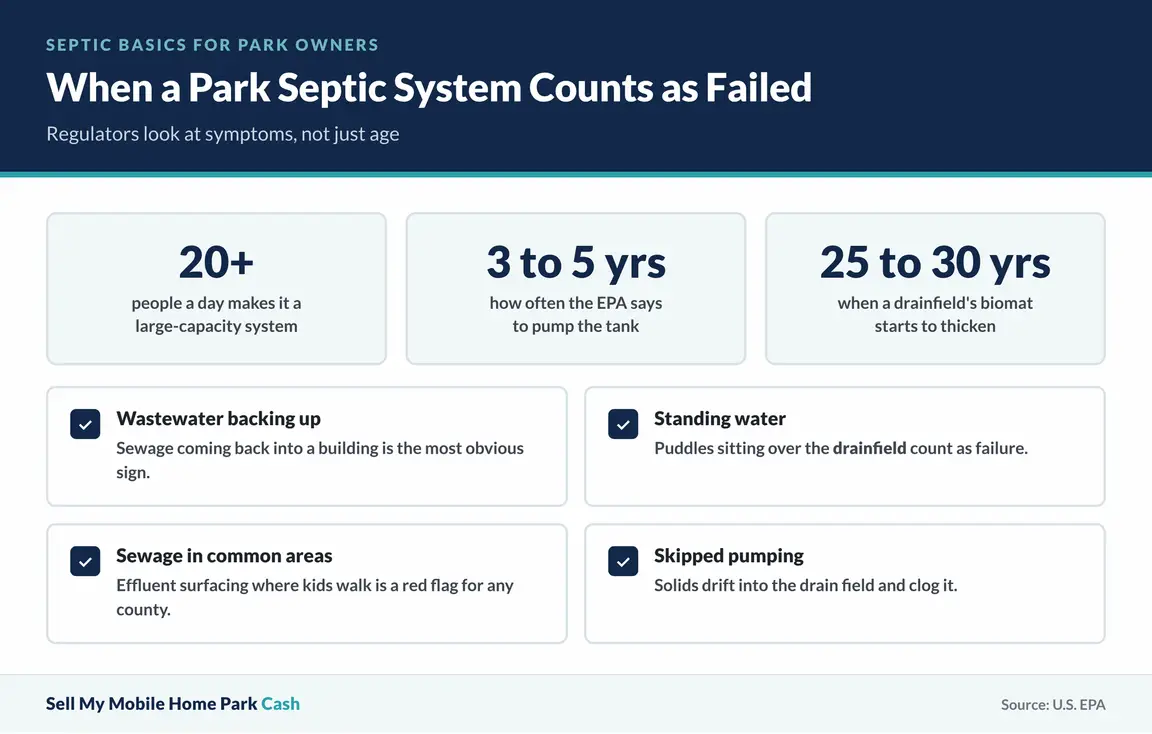
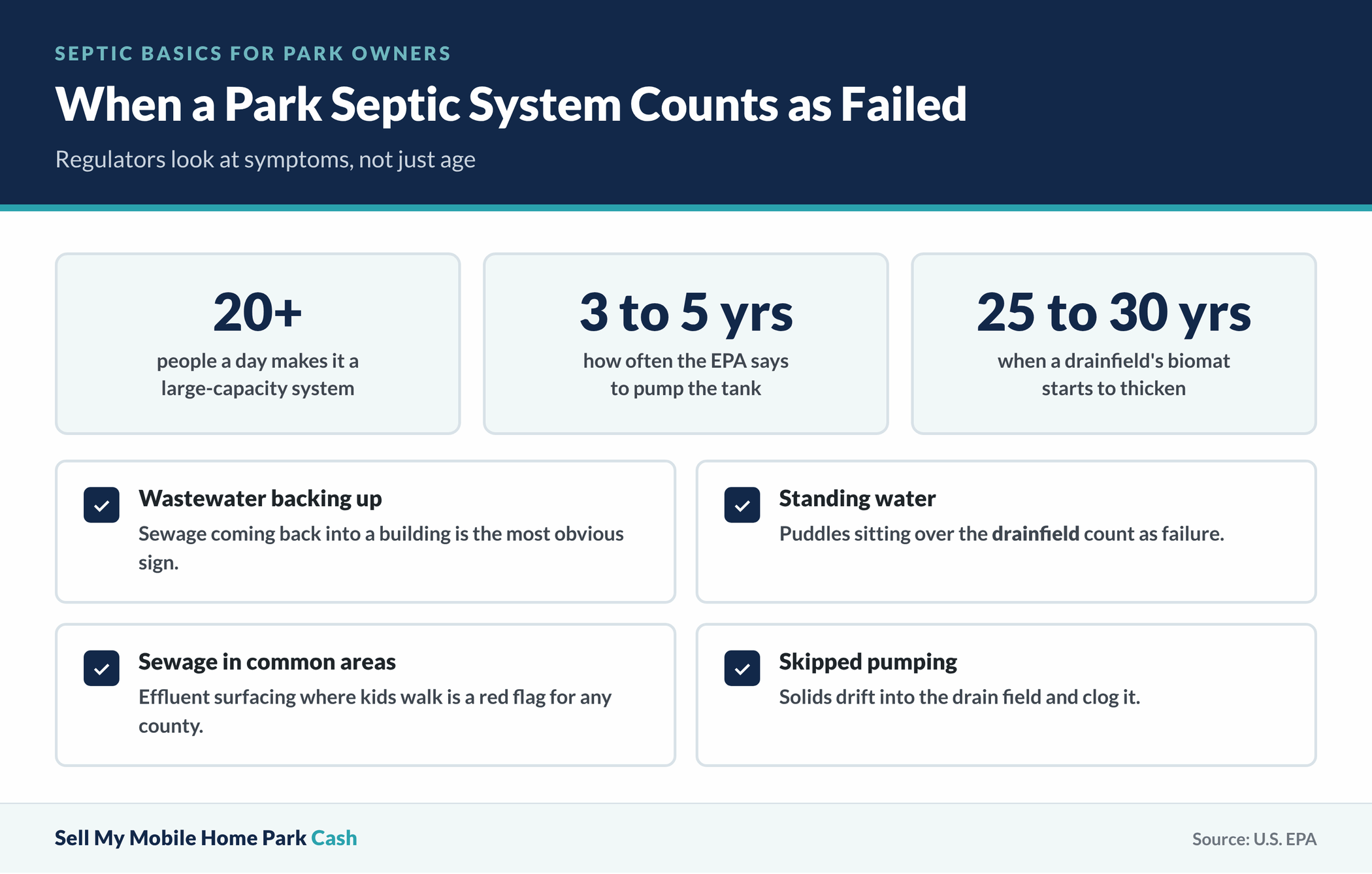
Regulators define it by symptoms, not age. The EPA’s guidance for decentralized wastewater management points agencies toward failure criteria you can see and smell. Wastewater backing up into a building is the most obvious one. Standing water over a drainfield counts. So does sewage surfacing in a common area where kids walk.
Buyers face a federal wrinkle with park systems that single-family homes don’t carry. When a septic system takes sanitary waste from multiple dwellings and can serve 20 or more people a day, the EPA calls it a large-capacity system. That label puts it under the agency’s Underground Injection Control program as a Class V well. Most parks with more than a handful of occupied lots clear that threshold easily. Your system may be federally inventoried even if you’ve never heard from anyone about it. Day-to-day permitting still runs through state agencies and county health departments, so two owners in different states can face very different enforcement for identical septic problems.
Age alone doesn’t equal failure. The EPA notes that drainfields older than 25 to 30 years develop a thickened biomat in the trenches that slows how fast wastewater moves into the soil.
Why do park systems fail faster than residential ones? Load. A drainfield sized in 1978 for twelve homes with one bathroom each is now absorbing the output of twelve homes with washers, dishwashers, and three people per unit. The system’s working far harder than anyone planned for. Skipping routine maintenance, specifically pumping the tank every three to five years, lets solids drift into the drain field and clog it. Deferred pumping across a whole park compounds into real septic problems fast.
What Happens to Your Mobile Home Park Sale When Septic Problems Surface
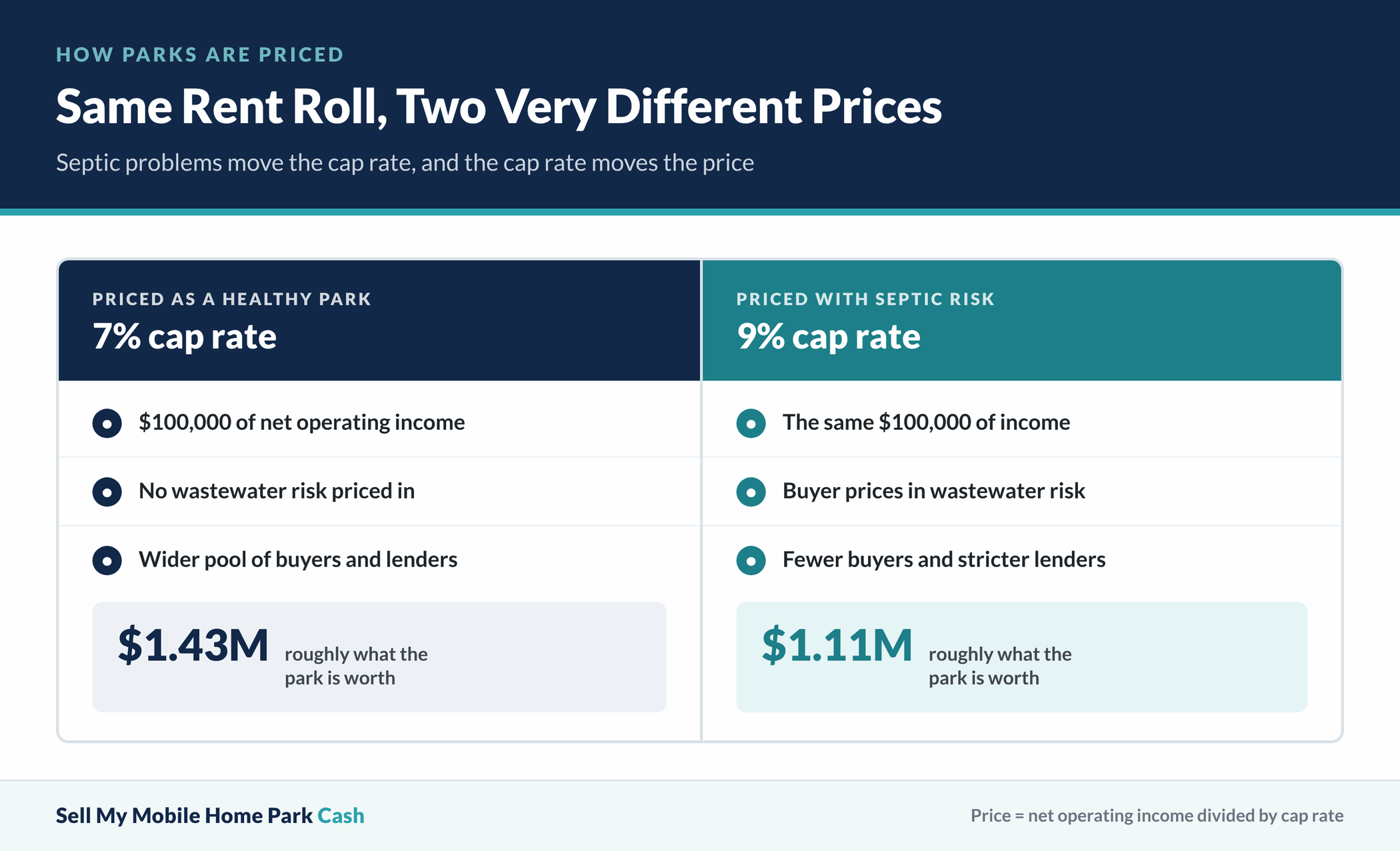
A hundred thousand dollars of NOI at a 7 percent cap rate is a park worth roughly $1.43 million. Shift that cap to 9 because a buyer is pricing in wastewater risk, and the same income only supports about $1.11 million. Nothing about your rent roll changed. The discount came entirely from perceived septic problems.
That’s the mechanism nobody explains at the kitchen table. Parks aren’t priced like houses; they’re priced off income divided by a yield number, and septic problems move the yield number. Northmarq reported that parks in smaller or more remote markets closed at cap rates approaching or topping 10 percent in the second quarter of 2026. Your park drifts toward that end of the scale the moment an inspector writes the word “failing.”
Some investors ask for a price reduction matched to a bid. Others want an escrow holdback until the repair clears final inspection.
Early last year I worked with a family outside Muncie, Indiana who’d inherited a 38-lot park. For close to eleven months they’d been quietly covering two mortgages, their own home plus the park note. Their drainfield replacement bid sat unsigned on the kitchen counter the whole time. They’d lost two conventional buyers to the same inspection report. We closed in under a month and took the system as it stood.
The holding cost is the part that actually bleeds you. Every month you spend chasing a buyer who won’t accept septic problems is another month of taxes, insurance, debt service, and pumping bills. I’ve watched owners spend more on carry than the repair would have cost.
Do Buyers Treat an Old Septic System Differently Than a Failed One
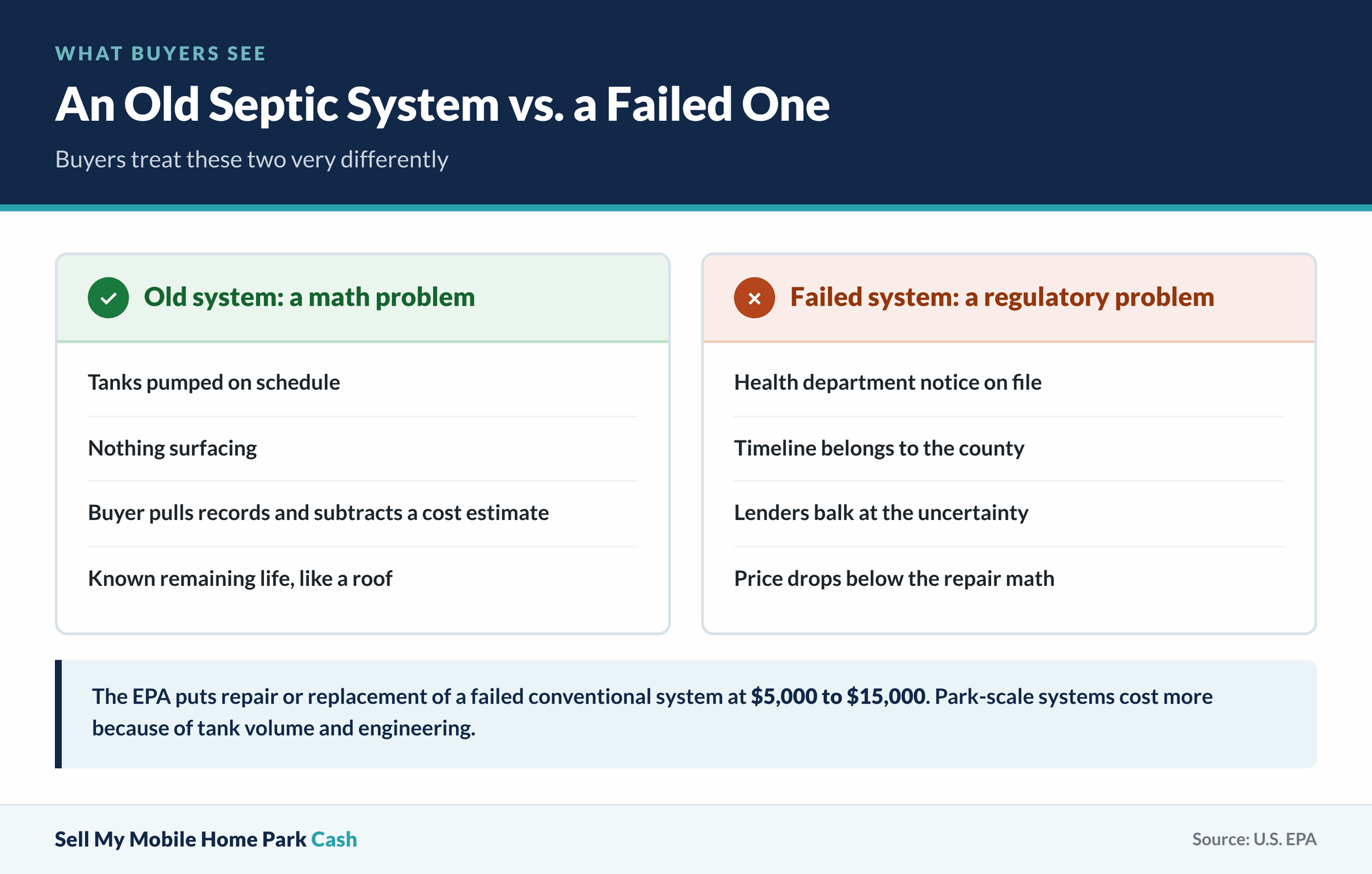
Yes, and the gap between those two categories runs wider than sellers tend to price for.
An old system is a math problem. A failed system is a regulatory problem, and those are not the same animal. Experienced park buyers underwrite aging infrastructure constantly; it’s half of what value-add investing is. They’ll pull the pumping records, look at the drainfield’s install date, run a cost estimate, and subtract it from their offer.
A system under a health department notice brings a timeline that belongs to someone else. The buyer can’t control when the county signs off. Lenders hate that uncertainty, and I’ll argue it’s the single biggest reason failed systems sell for less than their repair cost would suggest.
Getting a handle on repair costs helps anchor the conversation. The EPA estimates that repairing or replacing a failed conventional septic system runs $5,000 to $15,000, with alternative systems costing more. Park-scale systems sit above that, often far above, because of tank volume and engineering. Still, knowing the residential baseline keeps a buyer from pretending your septic problems are catastrophic when they aren’t.
Here’s where sellers hurt themselves: they treat an old system like a failed one in their own heads and discount preemptively. Don’t. If your tanks are getting pumped on schedule and nothing’s surfacing, you don’t have septic problems. You have an asset with a known remaining life, which is true of every roof and every water line in America.
Pumps are their own category. EPA guidance notes that many pumps and controls need replacing every 10 to 20 years.
What Legal Obligations Do Park Owners Have When Septic Problems Exist
If sewage is surfacing where residents live, stop negotiating and call your county health department before you call anyone else.
Enforcement authority for septic problems sits in layers, and the layer that reaches you first is almost always local. There’s no federal permit for a conventional residential septic system. The EPA leaves onsite wastewater regulation to the states, which hand permitting down to county health departments or licensed local agents. Your county office can tell you whether your park is under an active order and what the cure period is. Staff there can also describe what a compliant replacement would look like on your soil.
Federal exposure exists too, and it’s real for parks specifically. Large-capacity cesspools were required to be closed by April 5, 2005. That ban applies nationwide. Any part of your park still running on an open-bottom cesspool, rather than a tank with a leach field, is a compliance matter and not a maintenance one. Systems with a buried tank, an effluent distribution system, and a soil absorption area are considered septic systems, not cesspools.
Sellers face different disclosure duties by state, and I won’t pretend otherwise. Some states require written disclosure of known defects on commercial transfers; others treat commercial sales as caveat emptor with carve-outs for fraud.
Tenant-facing obligations run parallel to all of this. Habitability standards in most states cover working sanitation, so septic problems that leave homes without functioning drains can trigger rent abatement claims even in the middle of a sale.
Why Disclosing Septic Problems Up Front Protects Your Park Sale
Sellers picture disclosure as handing a buyer a club to beat the price down with. The buyer reads the report, discovers septic problems, and immediately demands twenty grand off. Reasonable fear.
What happens in practice runs the other direction. A buyer who learns about a failing drainfield from your own disclosure packet on day one prices it once and moves forward. Someone who discovers the same thing from an inspector on day forty re-prices it. Then they re-price everything else too, because now they’re wondering what else you didn’t mention.
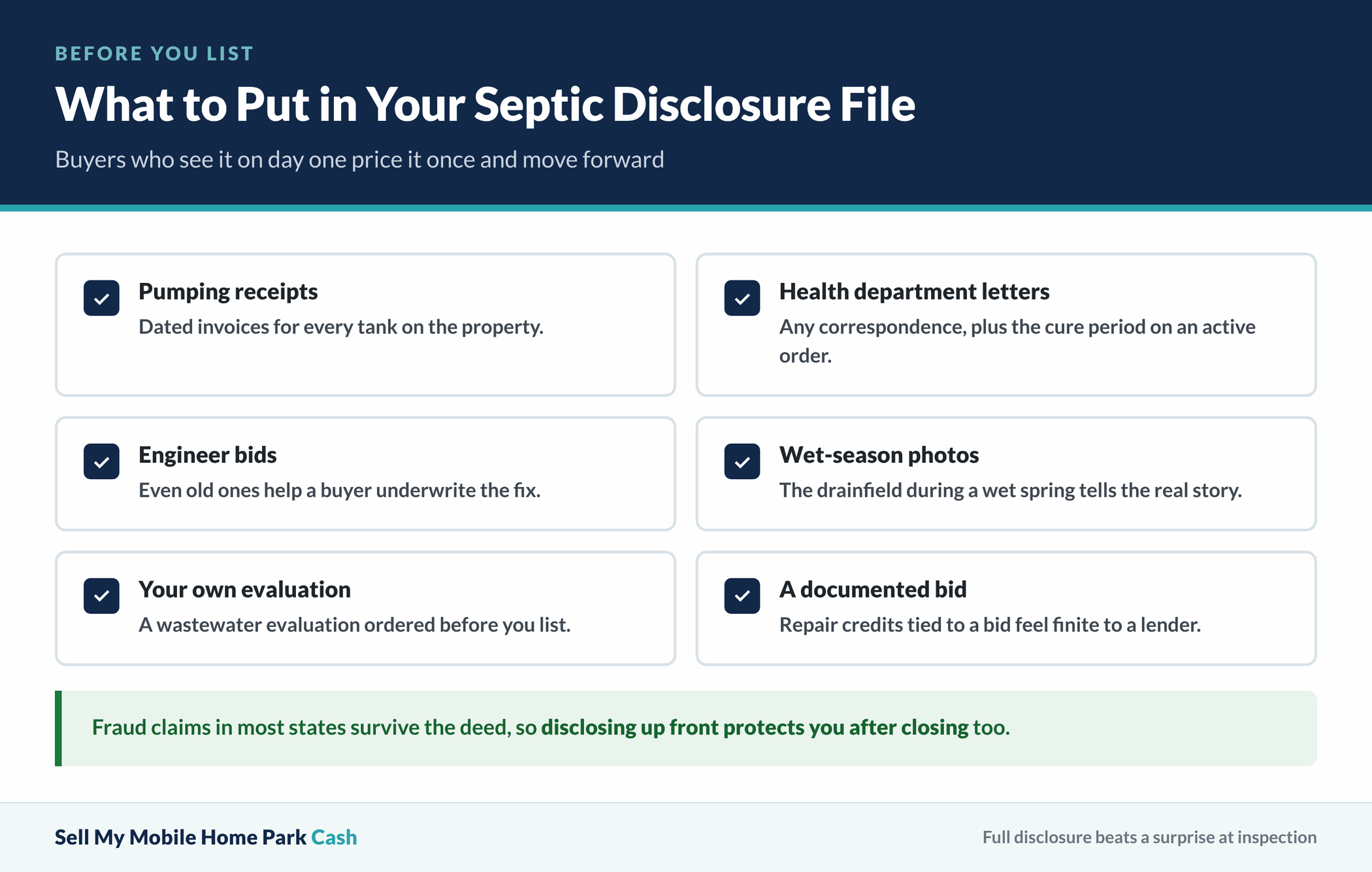
I’ve bought parks where the seller handed me a three-year file of pumping invoices and a failed perc test. After reading it, I raised my offer, since I could underwrite it precisely instead of padding my number for unknowns.
If someone concealed septic problems from you, would you still trust their rent roll?
The documentation that helps most is boring. Pumping receipts with dates and any correspondence from the health department belong in the file. Engineer bids help too, even old ones, along with photos of the drainfield during a wet spring.
You carry a tail risk that outlasts your closing. Fraud claims in most states survive the deed. Anyone who can show you knew about septic problems and stayed quiet has a path to come back at you. Transparency costs you a negotiation, but silence can cost you the sale twice.
How the Inspection Report Changes Who Holds Leverage in Septic Sales
Selling a house means one walkthrough, and selling a park means several.
You’ll get a property condition assessment, usually a Phase I environmental report, and a separate wastewater evaluation with dye testing or camera work on the lines. Each report becomes a chance for the price to reset.
Before that report lands, you hold the cards. You know your system; the buyer is guessing. Once a licensed inspector writes “drainfield at or near capacity,” the conversation stops being about your park’s income. It turns into a number on a page that you didn’t write.
You can keep some of that leverage by getting your own inspection first. A seller-ordered wastewater evaluation, completed before you list, lets you present septic problems with context and a bid attached rather than reacting to someone else’s framing. It’s the highest-return check I see park owners write before a sale.
Buyer-side inspectors write conservatively, and I don’t blame them since their liability runs one direction. A field that’s functional but aging gets described in language that sounds like it’s about to fail tomorrow. Your own report, from a licensed local contractor who knows the county’s standards, gives you something to hold up against that.
Repair credits usually beat price reductions. A credit is tied to a documented bid and feels finite to a lender.
Owners who sell to cash investors skip most of this, since the buyer underwrites septic problems themselves and doesn’t need a third party’s blessing. Sell My Mobile Home Park Cash is one of the groups that works this way, buying parks in current condition without routing the wastewater question through an inspection contingency.
Why Lenders Make Septic Problems Harder Than Buyers Do
A buyer tours your park on a Saturday, loves the lot rents, and signs at full ask. Six weeks later his lender’s underwriter reads the wastewater report and the loan dies.
Agency and bank lenders apply their own standards to park infrastructure, and a system under health department review frequently falls outside what they’ll fund. Private capital is more flexible, but it costs more, which pushes the buyer’s required return up and your price down.
Lenders have narrowed the buyer pool in 2026, and the parks that still trade briskly tend to be well-occupied communities on city utilities. Notice that city utilities made that short list. Parks on private wastewater already sit a notch below in lender preference before any septic problems enter the picture.
Buyers prove demand exists through transaction volume. Berkadia reported that manufactured housing community transaction volume rose 47.1 percent year over year in 2025, with 460 communities changing hands. Local zoning and siting hurdles keep new community development constrained, as Northmarq noted heading into 2026. Nobody’s building replacements for your park. That scarcity is your leverage even with a bad drainfield.
Escrow holdbacks are the common workaround for septic problems, and they’re often worse for the seller than they look. Funds sit tied up until final county sign-off, and permitting on a park-scale wastewater replacement can run months.
A couple in Kalispell, Montana took a job transfer with five weeks to be out. Their 22-lot park had two tanks failing their perc test. This meant the usual financing timeline wasn’t going to work for them. We wrote the contract around their moving date instead of a lender’s timeline, and the boat went with them.
Frequently Asked Questions About Selling a Mobile Home Park with Septic Problems
For years I told sellers that connecting to municipal sewer was always worth doing before a sale, and I was wrong about that often enough to stop saying it.
Does Switching From Septic to a Municipal Sewer Connection Raise What a Park Is Worth?
Usually yes, and sometimes by more than the hookup costs, because you remove the infrastructure risk that pushes buyers toward higher yield requirements. Lenders treat city-connected parks more favorably, which widens your buyer pool. Tap fees, engineering, and trenching across occupied lots can still run into six figures on a mid-size park, and the city needs a main within reach. Get a written connection estimate from the utility before you assume the math works.
How Can I Tell Whether My Park Is on Septic or on City Sewer?
Start with your utility bills: a separate line item for sewer service almost always means you’re connected to a municipal system. If you’re only paying for water, or you’re on wells, you’re likely on a private wastewater system. Your county health department keeps permit records for onsite systems and can tell you what was approved for your parcel and when. Older parks occasionally run on a mix, with some lots connected and others still on tanks, so don’t stop at the first answer you get.
How Many Years Should a Leach Field Last?
A well-maintained conventional field commonly runs two to three decades before it needs replacement, though soil type, groundwater levels, and hydraulic load all push that number around. Park fields tend to age faster than residential ones simply because they handle more gallons per day than they were designed for. Regular pumping stretches the life meaningfully. Once a field starts surfacing effluent, rejuvenation is worth pricing before you accept a full replacement bid.
Will My Insurance Policy Pay for a Septic Leak?
Typically not, and this catches owners mid-sale. Standard property policies treat gradual failure, wear, and lack of maintenance as excluded causes, so a drainfield that slowly stopped absorbing isn’t a covered loss. Sudden, accidental damage, like a line crushed by equipment, sometimes gets covered depending on your policy language. Read your declarations page and call your carrier before you budget on insurance money that may never come.
Can I Sell a Park While It’s Under an Active Health Department Order?
You can, though the order travels with the property and your buyer pool narrows to people who’ve handled compliance work before. Full written disclosure of the order and all correspondence is the only defensible approach. Cash buyers who already own parks in your state are usually the fastest path, since they know the agency, the engineers, and roughly what the cure will cost.
Should I Fix the Septic Problems Before Listing, or Sell as Is?
Run the arithmetic both ways rather than defaulting to repair. Add up the bid, the permitting delay, the months of carrying costs while the work happens, and compare that against what you’d net selling in current condition. If your park’s income is strong and the fix is straightforward, repairing first often pays. When the system needs engineering, a new perc test, and a county hearing, selling as is frequently nets more and ends the uncertainty sooner.
Where the Park Market Stands for Owners With Septic Problems
Park values are still climbing nationally. Northmarq reported that the median sale price reached $62,000 per space in the first half of 2026, a new high for the sector.
Strong prices help you even with septic problems on the property, because a buyer is still paying for the land, the lots and the rent roll. The wastewater fix comes off that number instead of sinking the whole sale. It helps to see how our process works before you decide anything.
Talk With Us Before You Decide
If you’re sitting on a park with septic problems and you’re not sure which direction makes sense, I’m happy to talk it through with you. Bring whatever you’ve got: the pumping invoices, the engineer’s bid, the letter from the county, or nothing at all if that’s where you are. Sometimes the right answer is fixing it and listing it conventionally, and I’ll tell you that if it’s true. Other times it’s a straight cash sale through a group like Sell My Mobile Home Park Cash so you can stop writing checks for a system you don’t want to own anymore. Either way, there’s no pressure here and nothing you have to decide on a phone call.
Bring those papers to a quick call through our contact page, or fill out the short form below and we’ll reach out to you.
Helpful Mobile Homes Articles
- How Much Does It Cost to Remove a Mobile Home in Texas?
- Choosing the Right Buyer for Your Texas Mobile Home Park
- How to Manage a Mobile Home Park Effectively in Texas
- How to Prepare Tenants for the Sale of a Mobile Home Park in Texas
- Sell Your Mobile Home Park with Occupied Units in Texas
- Sell a Mobile Home Park with Title Issues in Texas
- Sell Your Mobile Home Park for Maximum Profit in Texas
- Zoning Issues When Selling a Mobile Home Park in Texas
- Pros & Cons of Texas Mobile Home Parks
- How To Accurately Value A Mobile Home Park Investment Property
- Mobile Home Park Eviction Process in Texas