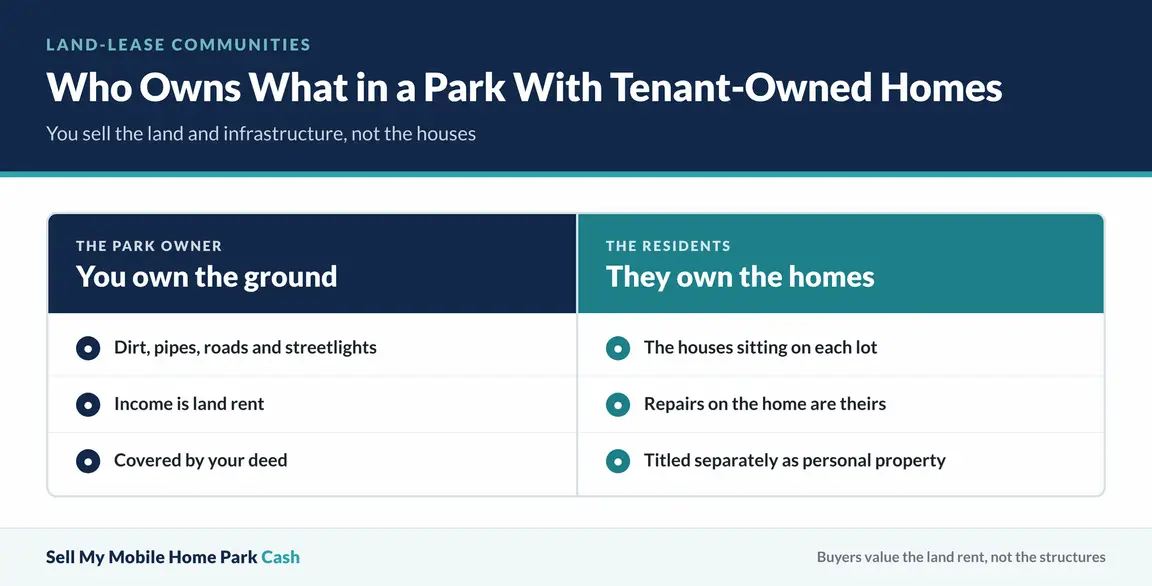
Years ago a buyer asked me what the roofs on my lots were worth. Nothing, I told him, since I didn’t own a single one of them. That’s the odd math of a land-lease community. You own the dirt, the pipes, the roads and the streetlights, and your residents own the houses on top. Selling a park full of tenant-owned homes is nothing like selling an apartment building, and sellers who treat it that way leave money on the table.
What Do Tenant-owned Homes on Leased Lots Mean for Buyers?
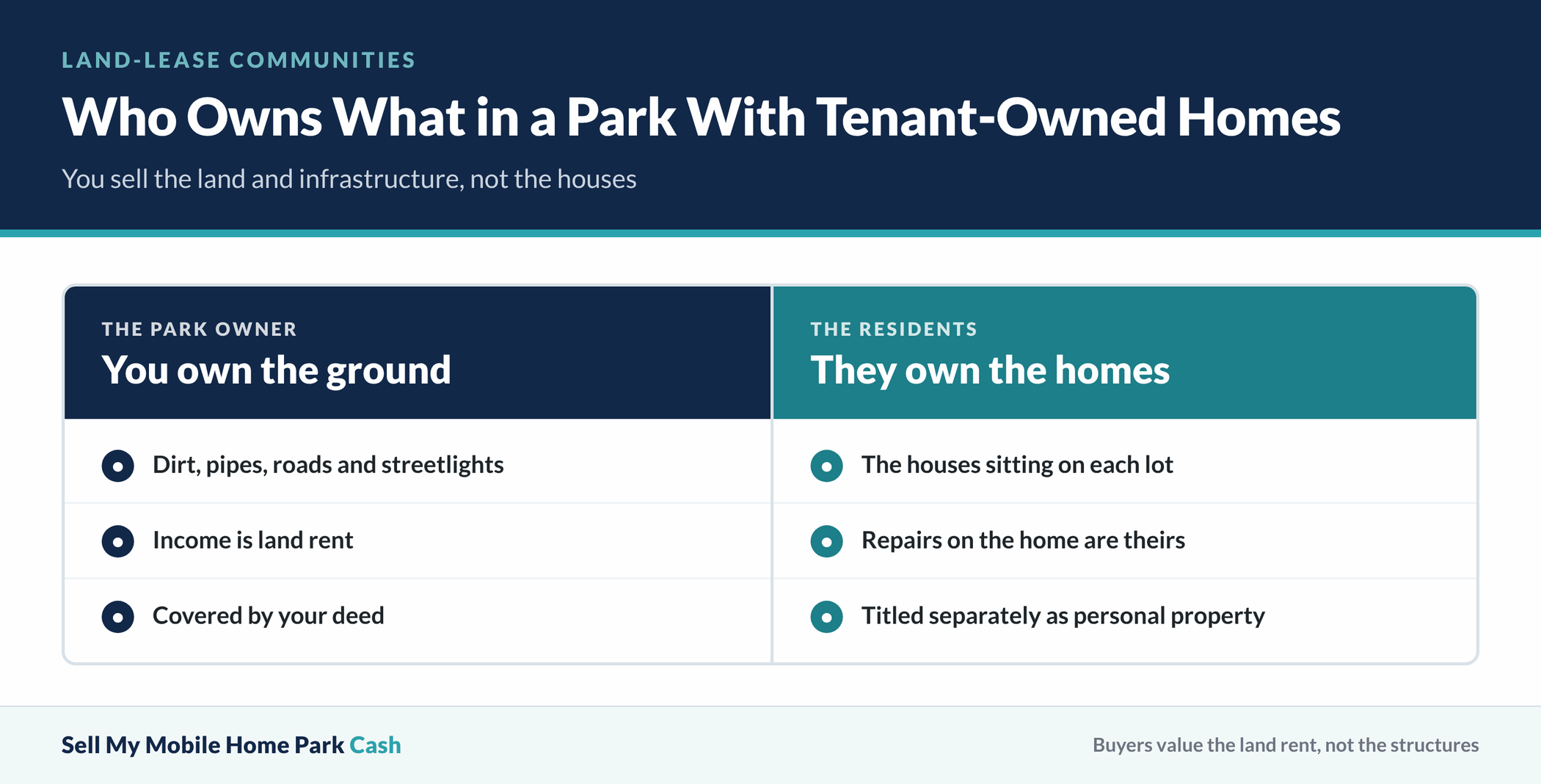
When the houses belong to the people living in them, your income is land rent. It comes in clean and steady, with almost no maintenance attached. Apartments lose a big share of their tenants every year. Mobile home park households that own their homes rarely move, because hauling a house somewhere else is slow and expensive.
A rent roll full of tenant-owned homes tells a buyer something about how the place runs. Expenses stay low, and net operating income holds up even in a rough year.
Most of the confusion starts in the park’s books. Plenty of sellers run both income streams through one P&L, and then a buyer can’t tell land rent from house rent. Separate them before anyone sees the numbers. Cap rates really do differ between park-owned and tenant-owned homes. A buyer who can’t pull your lot income out on its own will underwrite everything like a rental business.
Not long ago I worked with a retired couple outside Terre Haute, Indiana, who’d inherited a 38-lot park. For six years they’d been doing a job neither of them asked for. Squeezing out the top price wasn’t the point. They just wanted to stop collecting cash in person.
Tenant-owned homes made that exit easier than they expected. What a buyer takes on is the land and the infrastructure, not fifty aging structures with fifty separate problems.
How Do Leased Lots Affect the Value of Your Mobile Home Park?
Two numbers decide what your park sells for, and lot rent is only one of them. The other is how many lots hold tenant-owned homes and how many sit as vacant pads. An empty lot produces nothing, and filling it costs money.
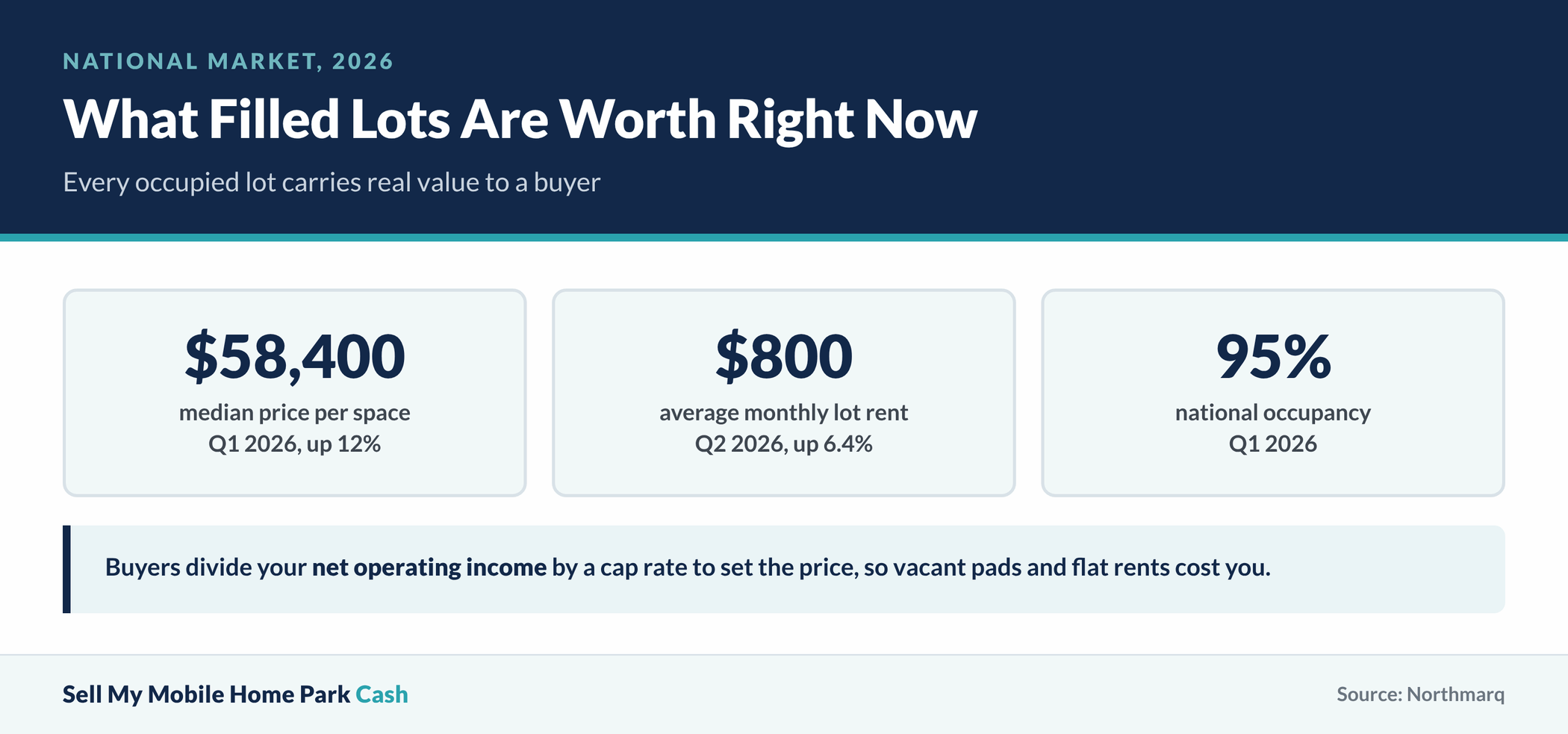
A buyer takes your net operating income, divides it by a cap rate, and there’s your price. Northmarq pegged the median price per space at $58,400 in Q1 2026, up 12%. That’s roughly what each filled lot is worth nationally. Lose four occupied lots and six figures of value disappear.
Lot rent that trails the market hands buyers easy upside. If you’ve left rent flat for a decade, you lose negotiating power right there. Northmarq put the national average at $800 a month in Q2 2026, growing 6.4% a year. I’ve seen that growth rate alone move a buyer’s offer. Parks sitting well under their local comps get priced on today’s income, not tomorrow’s.
Occupancy carries the rest. National occupancy hit 95% in Q1 2026, and that’s the bar buyers hold you to. Run below it and they’ll assume something’s wrong, then go looking for it.
I’d push back on one piece of broker advice: converting tenant-owned homes into park-owned rentals before a sale to goose top-line revenue. It inflates gross income and buries you in repair bills, and the buyer will normalize those right back out. You end up doing the work for somebody else’s spreadsheet. Teams like Sell My Mobile Home Park Cash underwrite parks like this regularly and can tell you fast whether your lot mix helps or hurts your number.
What Happens to Leased Lots When a Park Owner Sells the Property?
Every resident asks the same question the week word gets out: does my lease survive?
Generally, yes. Existing lot leases transfer with the land, and the new owner steps in as landlord.
Account for every deposit you’re holding and hand the buyer a schedule at closing. Any missing deposit turns into the new owner’s legal headache, and then into your indemnity claim.
Month-to-month arrangements with tenant-owned homes deserve a closer look. A park full of verbal, undocumented tenancies is a park full of uncertainty, and lenders notice.
Utility billing transfers too, and it trips people up. If the park submeters water and recovers the cost through monthly charges, there’s extra paperwork to hand over. The buyer will need the billing records, the meter readings, and any approval the state utility regulator required.
Closing works like any commercial real estate transaction, with title work on the land, a survey, an environmental review, and prorated rent at settlement. The homes never show up on the deed, because tenant-owned homes are titled separately as personal property.
Homes abandoned on your lots have to be resolved before closing, one way or another. No buyer wants an open title problem tied to a structure nobody claims.
Do Tenants Have Rights When You Sell a Mobile Home Park?
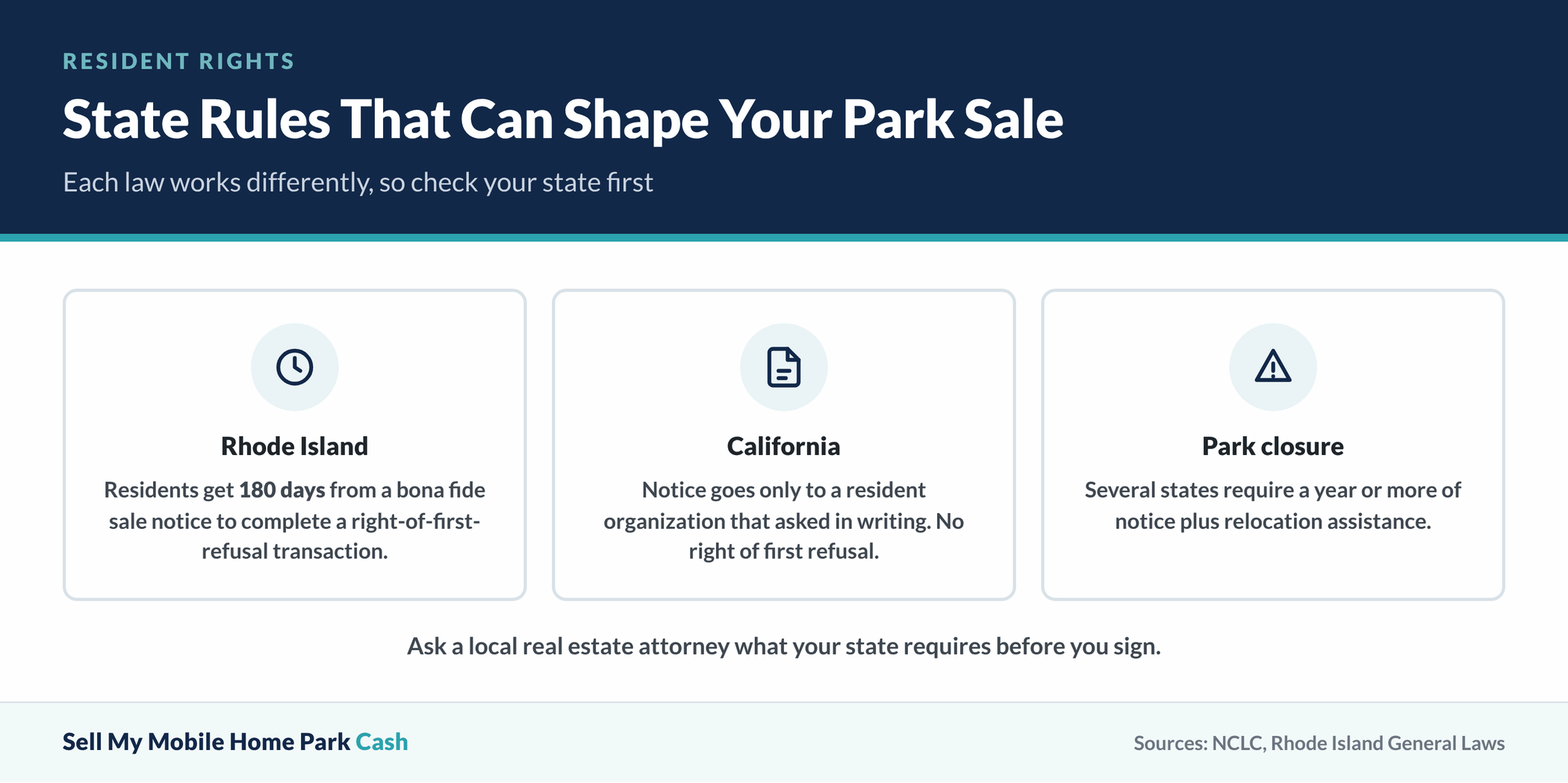
The National Consumer Law Center tracks a minority of states that give residents notice of a sale or a chance to buy. Each law works its own way. In Florida (for some sales), Massachusetts and Rhode Island, residents hold a right of first refusal once they’re notified. The rest of the country has no rule like it.
Rhode Island gives residents 180 days from receipt of a bona fide sale notice to complete a right-of-first-refusal transaction. Plan around that window. California only requires notice to a resident organization that has told the owner in writing, and repeated it every year, that it wants to buy. Even then, there’s no right of first refusal. Two states, two very different sets of obligations.
Before you sign anything, ask a local real estate attorney what your state requires when a park with tenant-owned homes changes ownership. That answer costs far less than a sale that comes apart.
Residents usually keep protections around selling their own homes in place, too. Many states limit whether a park can turn down a buyer, charge an entry fee, or force a home off the lot.
Park residents tend to get longer eviction notice and narrower grounds than ordinary renters, since their homes can’t easily leave. Sellers who assume standard residential timelines apply to tenant-owned homes get a surprise at the courthouse.
Closing the park is the one scenario with real teeth. Several states require a year or more of advance notice plus relocation assistance before a community can switch to another use. When your buyer plans to redevelop, that obligation belongs in the price from day one.
Who Pays Lot Rent When You Sell a Mobile Home Park with Tenant-owned Homes?
“If I sell mid-month, don’t I lose that rent?” You don’t. Prorations handle it like any income property.
You keep the days you owned the park, and the buyer keeps the rest.
Say a resident paid three months ahead. That money belongs to whoever owns the park during those months, so it shows up as a credit to the buyer at closing.
Delinquent rent is the real money question, and I’d settle it in writing instead of leaving it to custom. You’ve got two choices. The buyer can collect everything and forward your share as it comes in. Or you discount the arrears and let the buyer carry the collection risk.
Notification is where sellers get sloppy. Residents in tenant-owned homes need a written notice that tells them where to send payment and the date it starts. Texting or emailing alone isn’t enough for people who still mail checks. Confused tenants don’t pay, and a buyer whose first month of collections craters will remember who handled the handoff.
During negotiations, ask a prospective buyer who will physically collect the money after closing. A buyer with management already in your region can take over Monday morning, while an out-of-state newcomer may fumble the first cycle.
Can You Sell a Mobile Home Park with Tenants Behind on Lot Rent?
Yes. Stop waiting for a clean rent roll, because it isn’t coming.
Most buyers assume a few lots run behind. What they won’t tolerate is finding that out during due diligence after you implied collections ran at 100%. Finding them late reprices the park and poisons the trust you’ll need for the next thirty days.
Disclose the aging report up front. List every delinquent lot, the balance, how long it’s been behind, and what you’ve done about it.
So how much do delinquencies cost you at the closing table? Usually less than owners fear. Experienced operators underwrite economic occupancy instead of physical occupancy, and they’ll assume a collection loss no matter what your rent roll says. A park at 92% physical occupancy with 8% chronic delinquency gets valued near 85% economic occupancy, and that haircut is already baked into the offer.
Evicting your worst accounts before you list rarely helps. In a park with tenant-owned homes, an eviction creates a vacant lot plus an abandoned structure, so you’ve traded one problem for two. Most buyers would rather inherit a household that pays late than an empty pad.
Direct buyers treat a messy rent roll differently than listing brokers do. Sell My Mobile Home Park Cash underwrites parks with arrears on a regular basis. That spares you the cleanup work a traditional listing would demand before the first showing.
What Records Should You Pull Before Selling a Park with Tenant-owned Homes?
A seller in Chillicothe, Ohio once called me three days ahead of a scheduled closing, because nobody had checked the state titles on the homes.
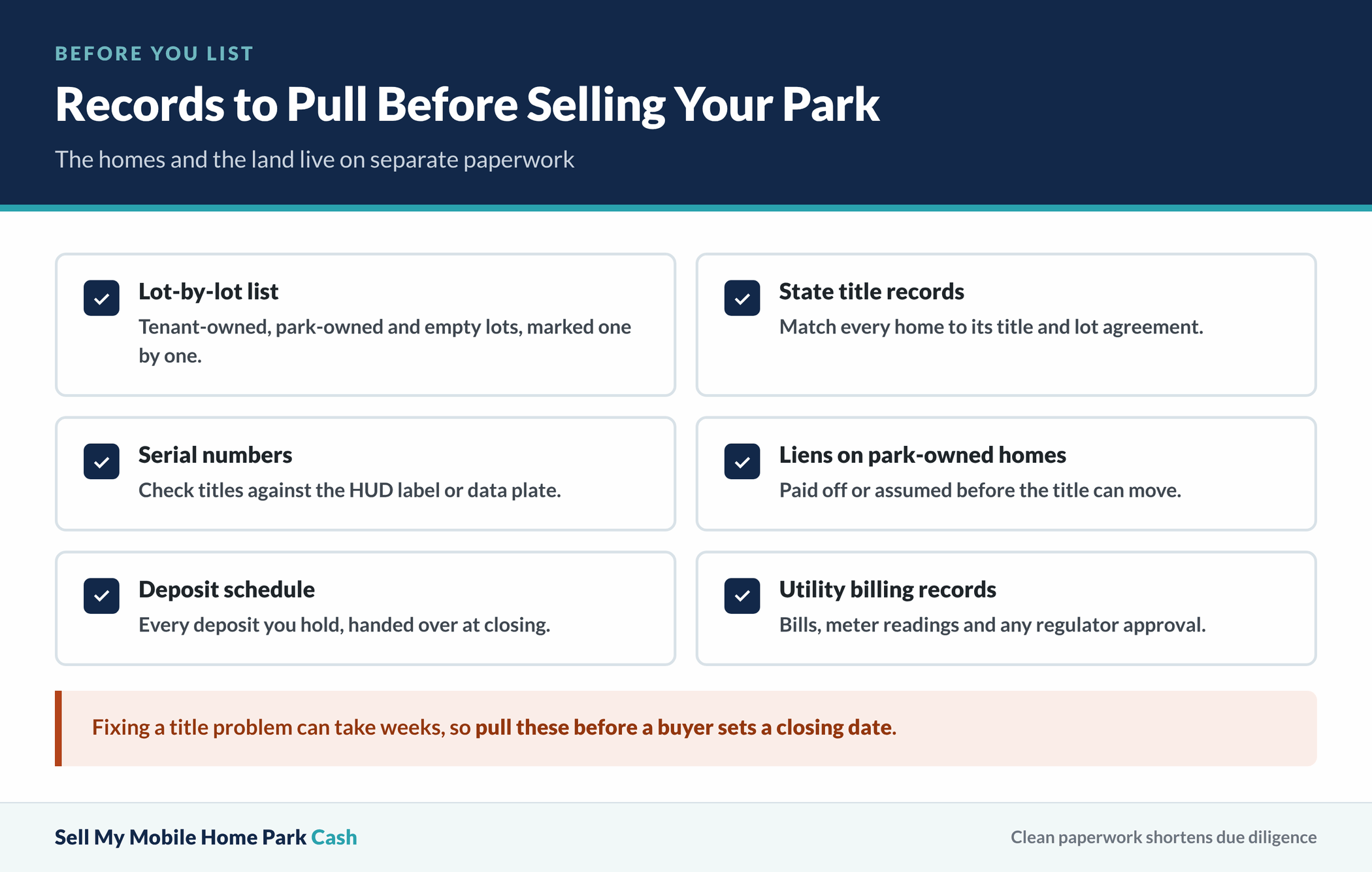
The homes and the land live on separate paperwork, which is why those records matter. Your deed covers the dirt, the roads and the utility lines. Each home has its own state title, and the buyer’s lender will want to know who holds every one before the sale closes.
Start with a lot-by-lot list. Mark which lots hold tenant-owned homes, which hold homes the park owns, and which are empty. Then match every home to its title record and to the name on its lot agreement. Older parks usually turn up a few mismatches, since homes change hands over the years without anyone telling the office.
Give park-owned homes a closer look. When the serial number on a title doesn’t match the HUD label or data plate, the state agency won’t process the transfer until someone clears it up. Check for liens on those homes as well, since a lender’s lien has to be paid off or assumed before the title can move.
Set the finished list beside your rent roll, and a buyer can see exactly which tenant-owned homes pay land rent and which lots earn nothing. Clarity like that shortens due diligence.
Pull these records before you list. Fixing a title problem through a state titling agency can take weeks, and you don’t want that clock running after a buyer has set a closing date.
How Do You Put Lot Rent Agreements in Writing for Tenant-owned Homes?
One park I reviewed had 61 lots and 9 signed leases. Six weeks of paperwork later, the owner had written agreements on 58 of them, and the buyer stopped asking for a price reduction.
Undocumented tenancies are the single most common value leak in parks full of tenant-owned homes. Even a handshake agreement from 2009 with a resident who’s never missed a payment looks like unverifiable income to a lender.
Every agreement should cover the basics, starting with the lot number, the monthly rent and the due date. Add late fee terms, who pays which utilities, and the rules for the home and the lot. Spell out your notice period for rent increases too, since statutes commonly require 30 to 90 days of written notice before new rules or rates take effect.
HUD’s Title I program calls for an initial lease term of three years when a borrower’s manufactured home sits on a leased lot. The lease also has to promise advance written notice of any termination. Residents who finance through that program need terms that meet those rules. A park that can’t offer them limits who can buy homes in your community.
Buyers and their lenders will ask for the file. No marketing package does more for your credibility than a well-organized binder of agreements on tenant-owned homes.
A daughter in Bozeman, Montana reached out while she was moving her father into assisted living. He’d run a small park for thirty years out of a filing cabinet in the detached garage. She found his lot agreements under a box of fishing tackle, and most hadn’t been signed since the Reagan administration.
Frequently Asked Questions About Selling Tenant-owned Homes on Leased Lots
Do I Need a Broker to Sell a Park Full of Tenant-owned Homes?
No, though plenty of owners list with a broker who specializes in manufactured housing communities. Brokers bring marketing reach and lender contacts, and their commission comes out of your proceeds. Selling straight to a buyer skips both the listing and the commission, which suits owners who care more about a clean exit than the last dollar.
What Happens to Pre-1976 Homes When I Sell the Park?
Homes built before June 15, 1976 predate the federal HUD construction standards. Many communities won’t accept them, and transport companies often decline to move them. In practice those homes stay put for good, and buyers underwrite them that way. An older home in your park may also only resell for cash, which can slow turnover on that lot.
Can I Get a Mortgage on a Manufactured Home Sitting on Leased Land?
Not a conventional mortgage, because a mortgage secures land you own. Home buyers on leased lots generally use chattel financing or an FHA Title I loan, and both attach to the home itself as personal property. Limits like these narrow the buyer pool for tenant-owned homes in your community. Parks with longer written lot leases tend to see their residents’ homes resell faster as a result.
Does My Buyer Have to Honor the Lot Rents I’ve Been Charging?
Your existing written agreements bind the new owner for whatever term is left. Some states also cap how fast lot rent can rise, no matter who owns the land. Outside those states, a buyer can raise rent once the required notice period passes. If gentle rents for long-term residents matter to you, say so during negotiations and think about longer lease terms before closing.
Will Selling the Park Force Residents to Move Their Homes?
Not from the sale itself. Ownership of the land changes hands, and the tenant-owned homes stay exactly where they are with their leases intact. Displacement only comes up if a new owner plans to close the community and redevelop the site. Redevelopment triggers advance notice requirements, and sometimes relocation assistance, depending on your state.
How Long Does It Take to Sell a Park Full of Tenant-owned Homes?
A conventional listing with bank financing usually takes several months from listing to closing, and due diligence and loan approval eat most of it. Selling directly for cash can close in weeks, since there’s no appraisal contingency and no lender underwriting the rent roll. Clean paperwork shortens either timeline more than anything else you can do.
Where the Market Stands for Parks Full of Tenant-owned Homes
Prices kept climbing after the first quarter. Northmarq reported that the median sale price reached $62,000 per space by midyear 2026, past the previous peak from 2022.
Parks where residents own their homes tend to draw strong interest, because land rent carries fewer repair bills than rentals do. Infrastructure still counts, though, and a park with septic or sewer trouble prices differently.
It’s worth seeing how our process works from first call to closing, and there’s no obligation at any step.
Talk With Us About Selling Your Park
If you’re weighing a sale, I’d rather you decide with good information than with a broker’s pitch in your ear. Pull your rent roll, count your signed agreements, and compare what your lots earn with the park across town. Then, if you want a second set of eyes on the numbers, reach out to Sell My Mobile Home Park Cash and talk it through. There’s no pressure, no obligation, and no hard feelings if you decide to hold on another year.
You can also fill out the short form below, or use our contact page if you’d rather call.
Helpful Mobile Homes Articles
- How Much Does It Cost to Remove a Mobile Home in Texas?
- Choosing the Right Buyer for Your Texas Mobile Home Park
- How to Manage a Mobile Home Park Effectively in Texas
- How to Prepare Tenants for the Sale of a Mobile Home Park in Texas
- Sell Your Mobile Home Park with Occupied Units in Texas
- Sell a Mobile Home Park with Title Issues in Texas
- Sell Your Mobile Home Park for Maximum Profit in Texas
- Zoning Issues When Selling a Mobile Home Park in Texas
- Pros & Cons of Texas Mobile Home Parks
- How To Accurately Value A Mobile Home Park Investment Property
- Mobile Home Park Eviction Process in Texas